Molissa Udevitz
Family Engagement Coordinator

Molissa Udevitz
Family Engagement Coordinator
Who am I? Where am I from? What do I like? These are just some of the questions middle schoolers explore in this developmentally significant time of life, as they gain independence and try on different identities.
Alaska has one of the lowest college and career-training completion rates in the country, and one in five young people ages 16–24 is neither in school nor working. Students need help imagining what their futures could look like. Research shows that a strong sense of self helps students make a plan for the future and follow through on it. This identity formation starts in middle school.
The Lower Yukon School District (LYSD) recently tested a new 13-lesson middle school curriculum called Bridging to the Future. The 13 lessons help students explore key questions. AASB’s Alaska Family Engagement Center developed the curriculum with two LYSD leaders: Shanna Johnson, Curriculum Director, and Assiingaq Janet Johnson, Yup’ik Language and Culture Director. Some inspiration was also drawn from Sealaska Heritage Institute’s Haa Latseení (Our Strength) Course.
Students reflect on where they’re from with activities that include writing a personal Yup’ik introduction and collaborating to showcase what values are most important to their community (see photo from Marshall School).
The lessons then ask students to imagine where they’re headed with activities that match their strengths to community needs. Students have an opportunity to reflect on where they want to be in 20 years.
Assiingaq helped shape this lesson to focus on values collectively, rather than individual values. This better reflects Yup’ik culture. She also shared, “It is a traditional practice for elders and community members to observe students’ strengths and offer guidance on what they might do in the future.” This led to an early lesson where students identify who makes up their “support team”.
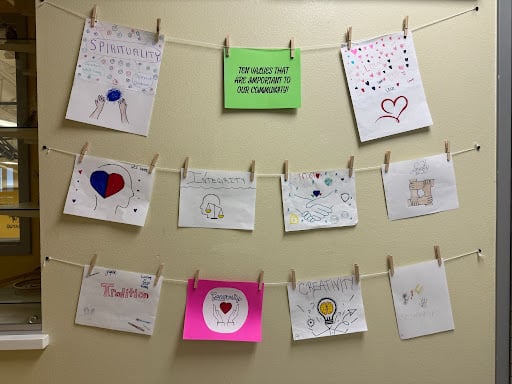
Marshall Middle School students worked together to identify these community values.
The curriculum incorporates family and community voices through family connection activities or homework where students ask caring adults about the topics in each lesson. Families can discuss community values or personal strengths. This helps spark conversations about the future at home and opens the door for stronger school-family partnership to support students’ future goals.
Families are an essential part of future planning because they know their kids best and stay involved in their lives after graduation, through potentially challenging postsecondary years
We can all play a role in helping students be ready for life after high school. Here are some ideas to get you started:
AASB can help with any of these things and more to strengthen your Planning for Life After High School strategies. Reach out to Molissa Udevitz mudevitz@aasb.org or Emily Ferry eferry@aasb.org and explore these educator and family resources.